
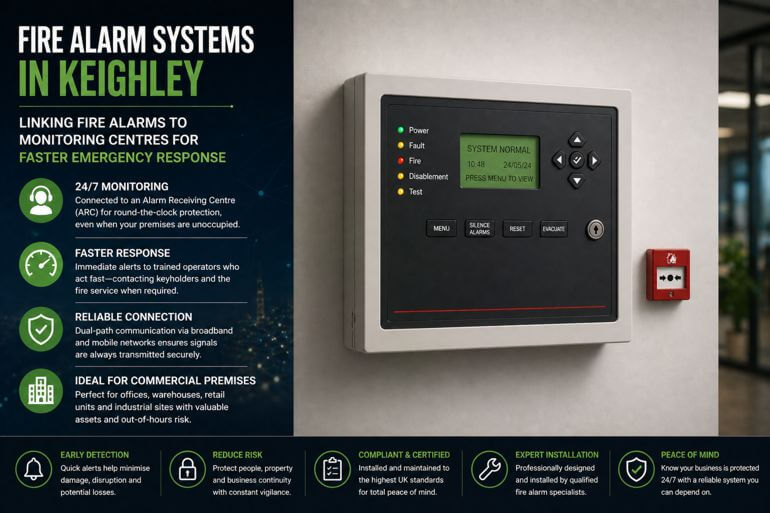
Monitored Fire Alarm Systems –
For many businesses in Keighley, fire alarm systems are designed to alert occupants within the building. However, in situations where premises may be unoccupied — overnight, at weekends or during holidays — this alone is not enough. This is where monitored fire alarm systems provide a significant advantage, ensuring that emergency services can be alerted even when no one is on-site.
A monitored fire alarm system is connected to an Alarm Receiving Centre (ARC). When the system activates, a signal is automatically transmitted to the monitoring centre, where trained operators assess the alert and take appropriate action. This typically involves contacting keyholders and, where necessary, notifying the fire and rescue service.
For Keighley businesses, this provides an additional layer of protection, particularly for premises containing valuable stock, equipment or critical infrastructure. Early notification can make a significant difference in limiting damage and reducing downtime.
One of the main benefits of monitoring is speed of response. Without monitoring, a fire alarm activation in an empty building may go unnoticed until significant damage has already occurred. With monitoring in place, the response process begins immediately, even if the building is unoccupied.
Monitored systems are particularly relevant for:
- Industrial units and warehouses
- Retail premises outside trading hours
- Offices with limited occupancy
- Buildings with high-value assets
In these environments, the ability to respond quickly is critical.
System reliability is essential for monitored setups. Signals must be transmitted securely and consistently to the ARC. This is typically achieved through dual-path communication methods, such as a combination of broadband and mobile networks, ensuring that the system remains operational even if one connection fails.
False alarm management is also important in monitored systems. Unwanted activations can lead to unnecessary callouts and potential charges. To reduce this risk, systems must be correctly designed, installed and maintained, with appropriate detector selection and configuration.
In Keighley commercial premises, regular maintenance ensures that detectors remain clean and calibrated, reducing the likelihood of false alarms. Monitoring providers may also implement verification procedures before escalating a response.
Integration with the fire alarm system must be seamless. The monitoring connection should operate automatically, without requiring manual intervention. This ensures that alerts are always transmitted when needed.
Keyholder arrangements are another consideration. Monitoring centres will typically contact designated individuals to attend the premises following an activation. These procedures must be clearly defined to ensure a coordinated response.
Compliance is an important factor. Monitored fire alarm systems must meet relevant standards and be installed by competent professionals. In Keighley, this ensures that systems are both reliable and recognised by insurers and regulatory bodies.
Testing is essential to confirm that monitoring links are functioning correctly. Regular tests should be carried out to ensure that signals are received and processed as expected.
Staff awareness remains important, even with monitoring in place. Employees should understand how the system operates and how monitored responses are handled.
For businesses with higher risk profiles, monitored systems can form part of a broader fire safety strategy. This may include integration with suppression systems or additional detection in critical areas.
Ultimately, monitored fire alarm systems provide peace of mind and enhanced protection, ensuring that a response is triggered even when no one is present to hear the alarm.
For businesses in Keighley, this means improved protection of assets, reduced potential losses and greater confidence that fire risks are being managed effectively at all times.