Fire safety responsibilities can feel complicated, but for Keighley businesses the core requirements are clear when broken down into straightforward, actionable steps.
This checklist highlights everything a commercial premises must have in place — with expert notes explaining why each item matters.
✔ 1. A Fire Risk Assessment That Specifies the Correct Alarm Category
Expert Note:
The category (L1, L2, L3, L4, L5, P1 or P2) determines the scope of your fire alarm.
Choosing the wrong one leads to non-compliance.
Many Keighley premises still operate systems that don’t match their current risk profile — especially older offices and converted mills.
✔ 2. Detectors Matched to the Environment
Expert Note:
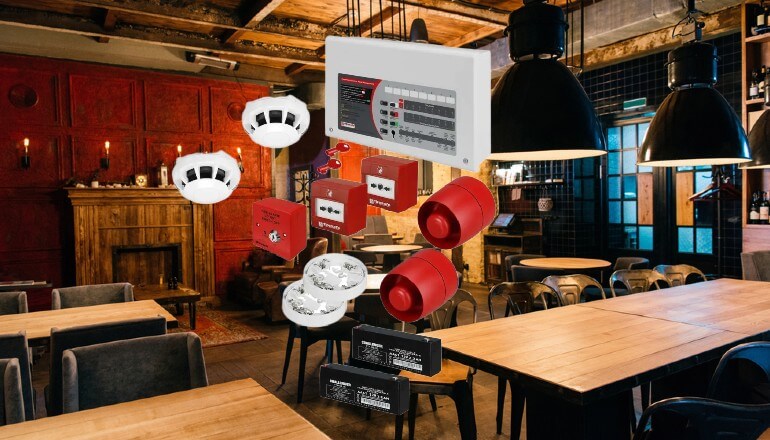
Each area needs the right detection technology:
- Optical smoke for offices and corridors
- Heat for kitchens or dusty environments
- Multi-sensor for false-alarm reduction
- Beam detection for large warehouse spaces
Keighley’s varied building stock means detector choice is rarely one-size-fits-all.
✔ 3. Clear Zoning and Accurate Labelling
Expert Note:
In a real emergency, responders need precise information — not guesswork.
Zones must reflect actual layouts, escape routes and building divisions.
Incorrect zoning is one of the most common issues found in older Keighley buildings.
✔ 4. Adequate Sounder and Beacon Coverage
Expert Note:
Evacuation signals must be:
- Loud enough
- Evenly distributed
- Clearly recognisable
- Supported by visual beacons where required
It’s not unusual to see silent pockets in buildings that have been extended or repurposed over time.
✔ 5. Documented Commissioning After Installation
Expert Note:
A commercial fire alarm is not compliant until commissioning is complete.
Commissioning checks:
- Device activation
- Sound levels
- Battery capacity
- Panel programming
- Cause-and-effect sequences
These documents are often requested by insurers and fire officers.
✔ 6. Weekly User Tests and Recorded Logbook Entries
Expert Note:
Every Keighley business must perform a weekly manual call point test.
It proves the system is operational and provides early warning of faults.
A missing logbook is a red flag during any audit or FRA review.
✔ 7. Periodic Engineer Inspections and Annual Servicing
Expert Note:
Routine maintenance prevents:
- Detector contamination
- Battery weakness
- False alarms
- Delayed activation
- Panel faults
Most businesses require at least two engineer visits per year, plus a full annual service.
✔ 8. Systems Updated When Building Layouts Change
Expert Note:
Refurbishments, new partitions, relocated kitchens or changed occupancy levels all affect fire alarm design.
If the building changes, the system must evolve with it — otherwise coverage becomes non-compliant.
✔ 9. Integration Where Required
Expert Note:
Modern commercial premises often need integration with:
- Door-release systems
- Emergency lighting
- Access control
- Sprinkler interfaces
- Monitoring centres
Integration ensures the building reacts automatically and consistently.
✔ 10. A Competent Provider for Design, Installation and Maintenance
Expert Note:
Commercial fire alarms are life-safety systems.
Choosing a provider with structured design processes and reliable support is essential for Keighley businesses that want confidence and long-term compliance.
Why This Checklist Matters for Keighley Businesses
A fire alarm system is not simply an installation — it’s an ongoing responsibility.
This checklist allows businesses to:
- Identify gaps
- Prioritise improvements
- Strengthen compliance
- Reduce risk
- Protect staff and assets
- Maintain insurance validity
A well-managed commercial fire alarm system gives Keighley businesses the clarity, consistency and safety they depend on.